PRODUCTS
RECRUIT
BUSINESS
Business

- BUSINESS
- Manufacturing Technology
Manufacturing Technology
Plating Process
- Description
-
- Dasan Solueta is an EMI shielding and thermal materials manufacturer with 100% integrated production from plating to adhesive coating. (Plant 1: plating process / Plant 2: adhesive coating process)
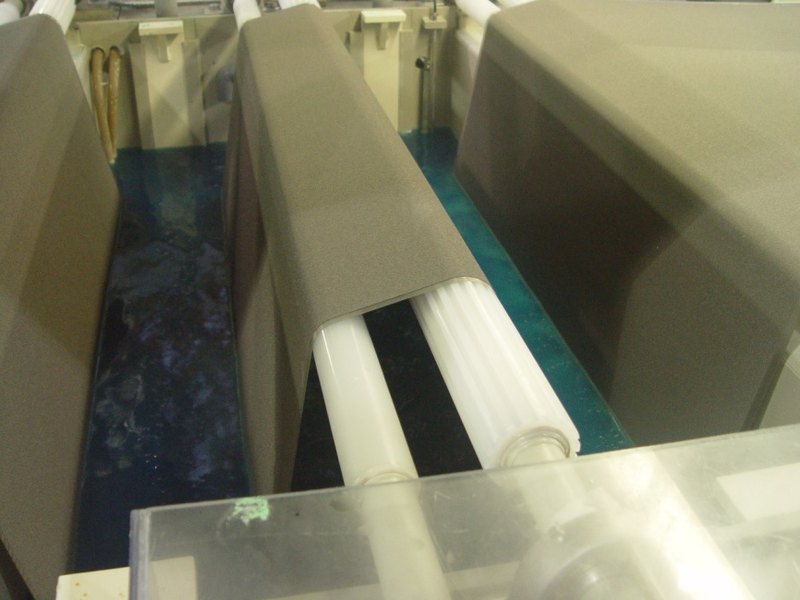
- We produce conductive fabric in-house by forming a uniform conductive layer on non-conductive polyester fabric through electroless and electrolytic plating.
- We hold 21 registered and pending patents related to EMI shielding, absorption and thermal management.
- Roll-to-Roll Continuous Plating Line
-
Unwind Pre-treatment Pre-Plating Main-Plating Rewind Polyester fabric input Degreasing · Pickling · Catalyst Ni · Cu
(Electroless)Cu · Ni
(Electrolytic)Conductive fabric output
- 14-Step Plating Process
-
Stage Process Steps Role Pre-Plating 01 Degreasing → 02 Pickling → 03 Pre-dipping → 04 Catalyst → 05 Activation → 06 Electroless Nickel → 07 Copper Sulfate → 08 Dehydration → 09 Drying Forms a uniform conductive layer
on non-conductive polyester fabricMain-Plating 10 Copper Sulfate → 11 Electrolytic Nickel → 12 Electroless Nickel → 13 Dehydration → 14 Drying Adjusts properties such as resistance 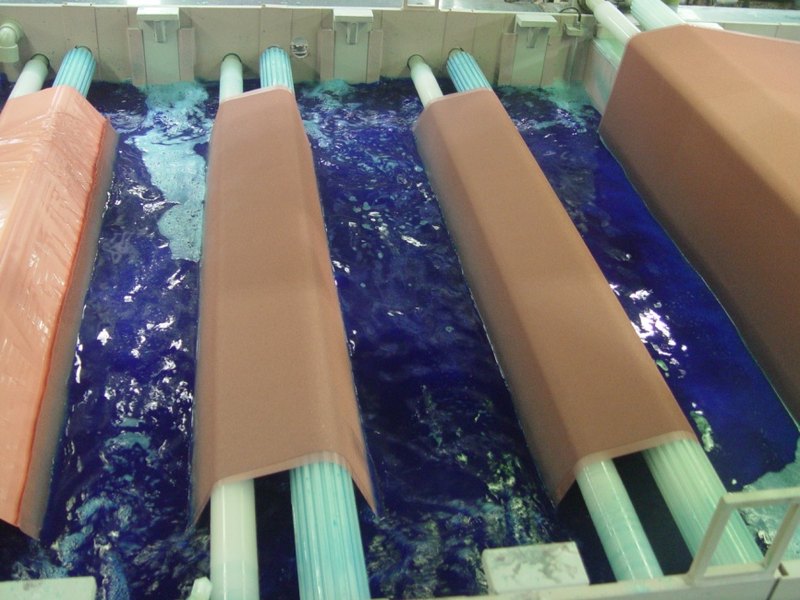
Electroplating vs Electroless Plating
- Description
-
- Electroplating : reduces metal ions using an external power source. Applicable only to conductive surfaces; fast plating speed and low cost.
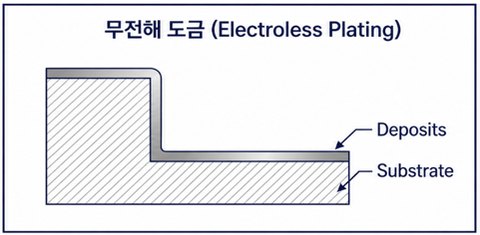
- Electroless Plating : deposits metal by chemical reduction without a power source. An essential step for metallizing non-conductors, with excellent uniformity.
- Comparison
-
Item Electroplating Electroless Driving Principle External DC power Spontaneous chemical reaction of the reducing agent in the plating bath Applicable Materials Conductors only Conductors and catalyzed non-conductors
(plastics · polyester)Deposition Uniformity Non-uniform depending on shape
(excessive deposition on edges/protrusions)Independent of substrate shape —
uniform, conformal deposition over the entire surfaceCharacteristics Fast plating speed · low cost Essential for metallizing non-conductors · excellent uniformity 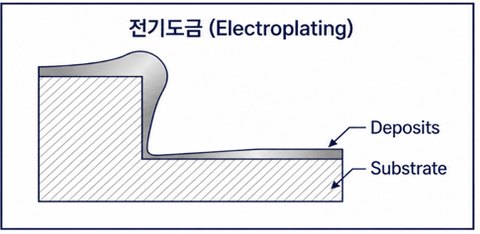
- Overcoming Non-Conductor Limitations (Plastics / Polyester)
-
Step Detail ① Etching Selective etching creates micro-roughness on the surface — ABS: butadiene removal / Polyester: ethylene glycol removal ② Catalyst Pd (palladium) catalyst nuclei are applied to the surface ③ Electroless Deposition Metal ions in the electroless bath are reduced and deposited around the exposed Pd nuclei, growing uniformly over the surface 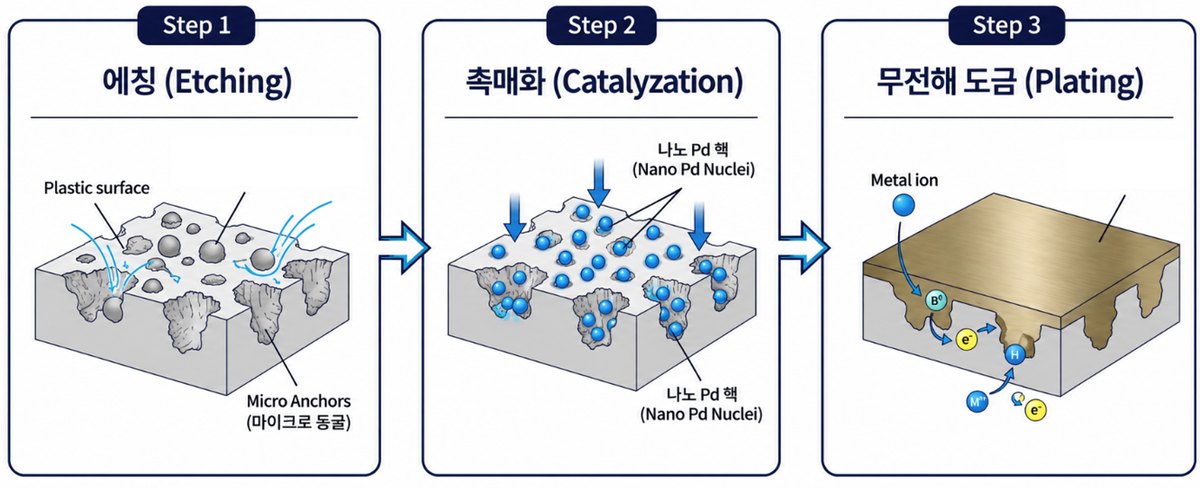
- Electroless Reaction
-
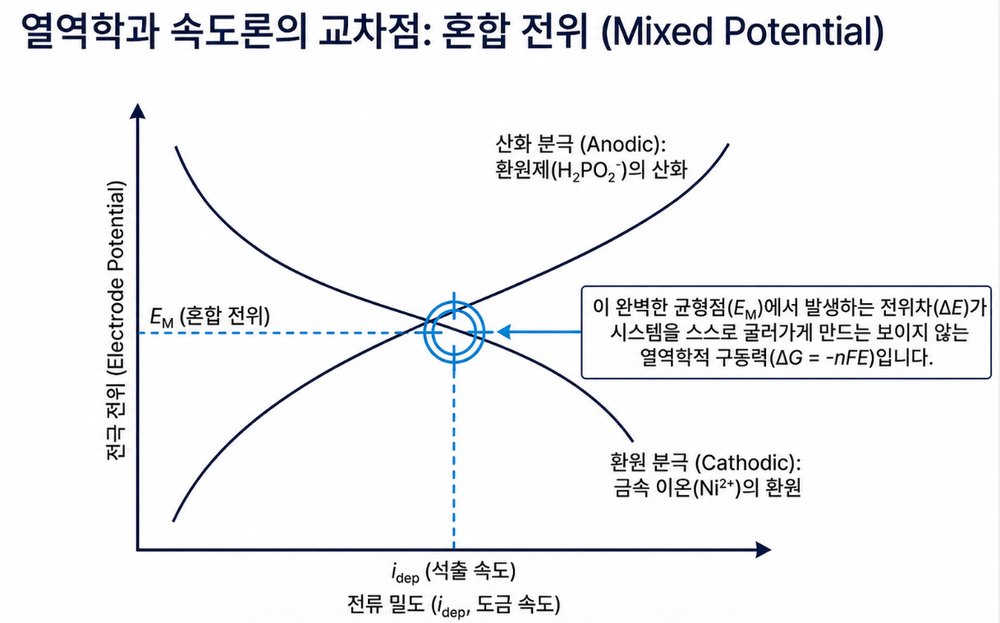
- R + H₂O → Ox + 2H⁺ + 2e⁻ (oxidation of the reducing agent)
- Mⁿ⁺ + 2e⁻ → M⁰ (reduction of metal ions) or 2H⁺ + 2e⁻ → H₂↑ (hydrogen gas evolution)
- At the mixed potential, oxidation and reduction rates are equal, so the reaction proceeds spontaneously without external power.
Metal Salt Reducing Agent Complexing Agent pH Adjuster Stabilizer Nickel Sulfate (NiSO₄) Sodium Hypophosphite (NaH₂PO₂) Ammonium Chloride (NH₄Cl) Ammonia (NH₃) Thiosulfate
- Example composition of a nickel plating bath
Adhesive & Coating Technology
- Description
-
- We coat our in-house plated conductive fabric with in-house formulated PSA, achieving integrated production through to the finished product.
- We design high-performance PSAs with Tg, adhesion, cohesion and heat resistance optimally tuned for each application.
- Adhesive Formulation Design
-
Base Polymer Functional Additives Result Elastomer Tackifier · Cross-linker · Softener · Antioxidant · Filler High-performance PSA
- Coating Method
-
Method Feature Detail Diagram Slot Die Precision Metered dispensing through a slot die — uniform across the web · high-precision coating 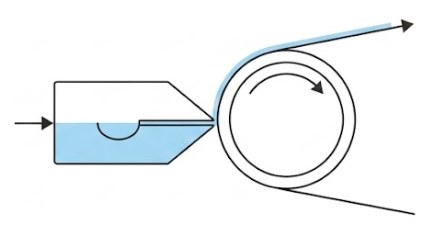
Comma Thick film Metered application with a comma knife — optimal for thick, uniform coating 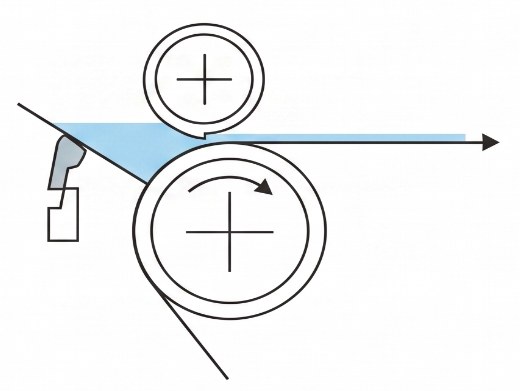
Gravure Thin film Precise transfer with a fine engraved roll — stable thin-film coating 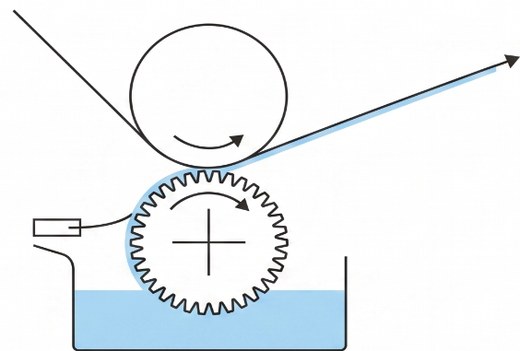
Micro-Gravure Ultra-thin film Uses a miniature engraved roll — ultra-thin, high-precision coating 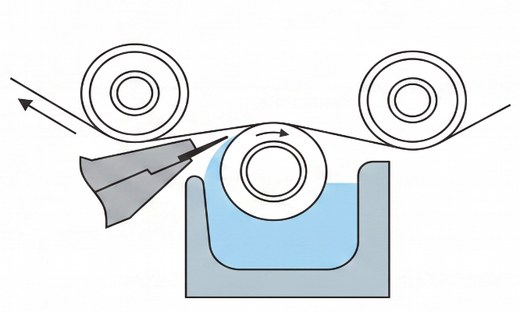

- Address.
- 498-42, Haeun-ro, Mado-myeon, Manse-gu, Hwaseong-si, Gyeonggi-do (18544)
- Tel.
- 031-508-2655
- E-mail.
- biz@solueta.com
(C) 2022. Solueta Co., Ltd. All rights reserved